

Sometimes you need residential rehab outside your comfort zone. Located about 105 miles from Oklahoma City, Great Plains Recovery in Tulsa offers patients a scenic place to get away from the triggers that contributed to their addiction.
The best path to recovery isn’t staying in the neighborhood, waiting months for a bed at a metro facility.
Clinical care is available in Tulsa to address the root cause of addiction (trauma, depression, and anxiety) in a setting far enough from home that allows you to stay connected to friends and family.
Why choose a Tulsa residential program over OKC outpatient care?
Oklahoma City residents choose our facility because it offers a full continuum of care, including medical detox and residential treatment, which can be limited or have waitlists in the OKC metro. Traveling to Tulsa provides a necessary therapeutic distance from enabling environments and local triggers, allowing for a total focus on the Sanctuary Model of trauma-informed care and family-integrated healing.
Key Takeaways
- Great Plains uses the Sanctuary Model to treat dual diagnosis (addiction and mental health) as the standard, not an exception.
- Leaving the OKC metro helps break the immediate people, places, and things that fuel active addiction.
- Weekly family involvement is woven into the process, acknowledging that recovery doesn’t happen in isolation.
- The facility is led by a Fellow of the American Society of Addiction Medicine, ensuring high-level care for complex cases.
Why Oklahoma City Residents Are Looking Beyond Local Options
The reality of the substance use crisis in Oklahoma is stark. According to SAMHSA’s National Survey on Drug Use and Health, Oklahoma continues to struggle with some of the highest rates of untreated substance use disorders in the country.
The Gap Between Need and Available Residential Care in OKC
Many people seeking help in Bricktown, Edmond, or Norman find that local resources focus primarily on outpatient services or short-term stabilization. While outpatient care is a vital part of the recovery spectrum, it often fails those dealing with the fourth wave of the epidemic, characterized by the dangerous co-use of methamphetamine and fentanyl.
When addiction has reached a point of daily chaos, staying in the same environment where the substance use occurs is a recipe for early relapse. A residential stay in Tulsa is not just a change of scenery. It is a change of pace that the high-energy environment of the OKC metro often cannot provide.
Is Residential Treatment Right for You?
If you are unsure if you or your loved one needs more than an outpatient counselor in OKC, consider these questions:
- Has there been a recent overdose, ER visit, or legal incident related to use?
- Have previous attempts at outpatient therapy or “going cold turkey” failed?
- Is the home environment currently unstable or filled with triggers?
- Are there underlying mental health issues like PTSD or depression that drive the use?
- Does the person require medical supervision to safely stop using substances?
- Is the person unable to maintain a job or family obligations due to substance use?
If you answered “Yes” to two or more of these, a residential level of care is likely necessary.
What Residential Treatment Near OKC Offers That Outpatient Can’t
Outpatient programs in Oklahoma City generally involve a few hours of group or individual therapy per week. The client returns home every night. For many, home is where the trauma lives or where the source of drugs is just a text away.
The facility offers a structured daily schedule from 8 a.m. to 6 p.m. that replaces the unpredictability of active addiction with purpose.
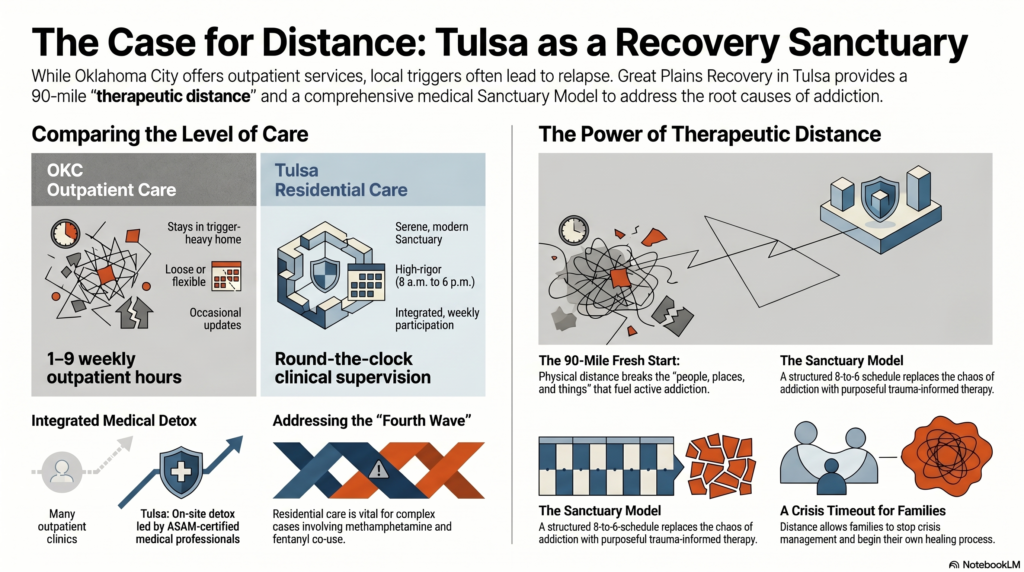
Residential rehab near Oklahoma City. Why Tulsa works.
Medical Detox, Dual Diagnosis, and the Full Continuum
Medical detox is the supervised withdrawal from substances under the care of medical professionals. It is the first hurdle. Our medical director is a Fellow of the American Society of Addiction Medicine (ASAM), meaning our detox protocols are rooted in the highest clinical standards.
Beyond detox, we address dual diagnosis. In Oklahoma, addiction almost never travels alone; it is usually a symptom of trauma, anxiety, or bipolar disorder. Our trauma-informed framework (the Sanctuary Model) ensures that every therapy session, from EMDR to Cognitive Behavioral Therapy, treats the person as a whole, not just a set of symptoms.
| Feature | Outpatient Care (General OKC) | Residential at Great Plains (Tulsa) |
|---|---|---|
| Supervision | 1 to 9 hours per week | 24/7 clinical and medical support |
| Environment | Stays in trigger-heavy home | Serene, modern sanctuary |
| Medical Detox | Rarely available on-site | Integrated medical detox |
| Daily Structure | Loose or flexible | High-rigor (8 a.m. to 6 p.m.) |
| Family Role | Occasional updates | Integrated, weekly participation |
If outpatient rehab hasn’t been enough, a confidential conversation with our admissions team at 918-731-3173 can help you understand what level of care fits your situation and whether the drive to Tulsa makes sense for your family.
The Case for Distance: Why Leaving OKC Can Be Part of the Treatment
There is a psychological benefit to the roughly two-hour drive down I-44. For a resident of Oklahoma City, Tulsa is far enough away to feel like a fresh start, but close enough that family can remain involved.
Separation From Triggers and Enabling Environments
In addiction medicine, we talk about people, places, and things. If every street corner in your OKC neighborhood reminds you of using, your brain remains in a state of high alert. By relocating to a serene environment in South Tulsa, that cognitive load is lifted. You are not worried about bumping into an old associate at the gas station; you are focused on your next EMDR session or your progress in group therapy.
This distance also helps families. It provides a timeout from the daily crisis management that defines life with an active user. It allows the family to breathe and begin their own healing process.
What to Expect From Tulsa Inpatient Rehab
The transition from Oklahoma City to our Tulsa facility is designed to be seamless. We understand that by the time you call us, you are likely in a state of exhaustion.
The Intake Process and Family Involvement
When you arrive, you are not entering a hospital or a halfway house. You are entering a modern, professional treatment environment. The intake process involves a comprehensive clinical and medical assessment to ensure we are meeting the ASAM criteria for your specific needs.
Family involvement is a clinical differentiator for us. We do not view families as bystanders. Throughout the residential and Partial Hospitalization (PHP) phases, we bring families into the process through dedicated therapy and education. We help families move from enabling to supporting, which is vital for long-term success once the client returns to OKC.
A Structured Daily Therapeutic Schedule
Our days are intentional. From 8 a.m. to 6 p.m., clients are engaged in a mix of:
- Individual Therapy: Working through the root causes of use.
- Group Sessions: Building community and practicing Dialectical Behavior Therapy skills.
- Trauma Processing: Utilizing EMDR to address the “why” behind the addiction.
- 12-Step Integration: Providing a foundation for community support after discharge.
Need Help Comparing Your Options?
Not ready to call yet? Download our free guide: 7 Questions to Ask When Choosing a Residential Treatment Center to help you evaluate programs across Oklahoma.
Finding Addiction Treatment in Tulsa From Oklahoma City
Great Plains Recovery serves the entire state, from the metro hubs of OKC and Tulsa to rural communities in western Oklahoma. We believe quality residential treatment should not require a flight to another state or an impossible out-of-pocket bill.
The center is located in South Tulsa, easily accessible via the Turner Turnpike. We accept most major insurance providers, and our admissions team handles the verification process so you do not have to navigate coverage complexities during a crisis.
Frequently Asked Questions
How do I know if my loved one needs residential rehab instead of outpatient care?
Residential care is typically necessary if previous outpatient attempts have failed, if there is a risk of severe withdrawal, or if the home environment is too unstable to support sobriety. If the addiction is compounded by mental health issues like PTSD or depression, the 24/7 support of a residential program is the safest option.
Does Great Plains Recovery accept insurance from Oklahoma City residents?
Yes. We accept most major private insurance plans. Because we are an in-state provider, we are often a more accessible option than out-of-state facilities that may not be in-network with Oklahoma-based policies.
Is it worth traveling from Oklahoma City to Tulsa for addiction treatment?
Often, yes. The ~105-mile distance provides a physical and psychological break from the local triggers and social circles that contribute to substance use, while remaining close enough for family members to participate in weekly therapy sessions.
How does residential rehab in Tulsa differ from outpatient programs in OKC?
Residential rehab provides a controlled, drug-free environment with 24/7 medical and clinical supervision. Outpatient programs only offer a few hours of therapy a week, leaving the individual to navigate their triggers alone for the remaining 160+ hours of the week.
What happens during the first week of residential treatment at Great Plains Recovery?
The first week focuses on medical stabilization (detox) and clinical orientation. Clients meet their primary therapist, undergo a full medical evaluation by our ASAM-credentialed medical director, and begin integrating into the structured daily schedule of the Sanctuary Model.
Can my family be involved in treatment if we live in OKC?
Absolutely. We consider family involvement essential. We offer scheduled family programming and therapy sessions that can be coordinated to make the trip from OKC manageable for spouses and parents.
Take the First Step
Recovery does not happen in isolation, and it rarely happens in the middle of the chaos that created the problem. Serving all of Oklahoma (including OKC, Lawton, and Enid), Great Plains Recovery provides the clinical infrastructure and human compassion needed to treat the whole person.
Call our admissions team at 918-731-3173 to learn more about our facility.
Great Plains Recovery is located at 7210 S. Yale Ave, Tulsa, OK 74136.
Helpful Resources
- SAMHSA National Helpline: 1-800-662-HELP (4357)
- 988 Suicide & Crisis Lifeline: dial 988
- Crisis Text Line: Text HOME to 741741
- National Institute on Drug Abuse: Treatment and Recovery
- OK I’m Ready: Oklahoma Recovery Resources
- National Institutes of Health: Inpatient vs Outpatient
- Oklahoma Mental Health & Substance Abuse