

Watching someone you love struggle with addiction is an exhausting, circular experience. To support a loved one with substance use disorder, you must shift your focus from managing their crises to offering a structured path toward professional treatment. This involves setting clear boundaries, stopping the cycle of enabling, and connecting them with clinical resources like medical detox or residential care.
Finding a quality rehab center in Oklahoma doesn’t have to be challenging. You want to find a center like Great Plains Recovery that offers each patient a step-by-step process on their treatment.
Quick Self-Check: Is Your Loved One in Danger?
If you answer “yes” to more than two of these, the situation has likely moved beyond what you can handle without professional intervention.
- Has their substance use led to a medical emergency or overdose? (Yes/No)
- Are they unable to maintain a job or household responsibilities? (Yes/No)
- Do they use substances like meth or fentanyl, which carry high immediate risks? (Yes/No)
- Have they tried to quit on their own and failed? (Yes/No)
- Is their behavior causing a constant state of crisis or fear in your home? (Yes/No)
- Have they faced legal consequences related to their use? (Yes/No)
Key Takeaways: Supporting a Loved One
- Prioritize Safety: If there is a risk of overdose or violence, professional help is an immediate necessity, not a future goal.
- Establish Boundaries: Helping often requires saying “no” to financial support or housing if it allows the addiction to continue.
- Clinical Depth Matters: Look for facilities that treat the underlying mental health conditions (dual diagnosis) alongside the substance use.
- Involve the Family: Recovery is rarely successful in isolation; the entire family system usually needs support and education.
What Families of People With Addiction Are Really Going Through
The guilt, the fear, and the exhaustion are normal
Most families arrive at our doors in Tulsa after years of trying to solve the problem themselves. You likely feel like you’re walking on eggshells, waiting for the phone to ring with bad news. This chronic stress is a form of trauma. You are trying to find the best way to support your loved one with Substance Use Disorder.
In Oklahoma, the stakes are incredibly high. Fentanyl and meth have changed the landscape, making the advice to wait for them to hit rock bottom dangerous. If you feel exhausted, it is because you’ve been doing the work of a clinical team without the training or the resources.
You didn’t cause this, but you can be part of the solution
We operate under the Sanctuary Model, which means we view addiction through a trauma-informed lens. This applies to you, too. You didn’t cause your spouse’s or child’s substance use disorder.
However, your role in the solution is vital. While you cannot “fix” them, you can change the environment around them. By shifting from a role of protector to a role of supporter, you create the space they need to face the reality of their health.
How to Talk to Someone About Their Substance Use
Choosing the right moment and setting
Don’t start a conversation when your loved one is high or coming down. The brain isn’t capable of processing logic or empathy in those moments.
Find a quiet, neutral space. If you’re in Tulsa, maybe it’s a walk at Gathering Place; if you’re in a more rural part of the state, find a spot away from the triggers of the home. The goal is to minimize the fight or flight response that often leads to blowups and slammed doors.
What to say (and what to avoid)
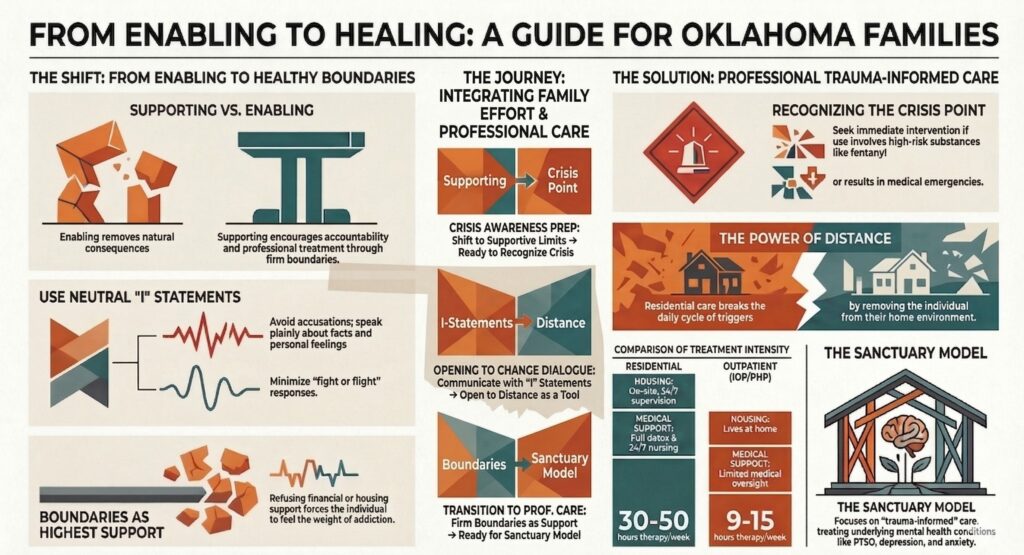
Avoid “you” statements that sound like accusations. Instead of saying, “You are ruining this family,” try “I feel scared when I see how much your health is declining.”
Speak plainly about the facts. Mention specific incidents, like a missed birthday or a dangerous driving episode. You aren’t being mean; you are being honest. Compassion in this context isn’t soft. It is firm and grounded in reality.
A Note for Families: You don’t have to figure this out alone. Our recovery specialists can help you understand your options at no obligation.
How to support a loved one with substance use disorder in Oklahoma.
The Difference Between Supporting and Enabling
Why enabling happens and how to recognize it
Enabling means removing the natural consequences of substance use in ways that allow it to continue. This includes covering bills, making excuses to employers, or minimizing the severity. Supporting means encouraging accountability and treatment while maintaining healthy boundaries.
Enabling usually comes from a place of deep love and a desire to prevent suffering. But in the context of addiction, preventing the “small” sufferings (like a late light bill or a night in jail) often prevents the “big” realization that treatment is necessary.
Setting boundaries without abandoning your loved one
A boundary is not a threat; it is a rule for your own well-being. It might sound like this: “I love you, and I want you to be healthy, but I will no longer give you money that I know is going toward drugs.”
Setting boundaries is the hardest part of the process. It feels like abandonment, but it is actually the highest form of support. It forces the individual to feel the full weight of their addiction, which is often the only thing that motivates a move toward residential treatment.
When to Seek Professional Help and What Treatment Looks Like
Signs it’s beyond what you can manage at home
If you are seeing these signs, the “at-home” approach has failed. It is time for a professional clinical intervention.
- Medical Emergencies: Any history of overdose or withdrawal seizures.
- Poly-drug Use: Mixing substances, such as opioids and benzodiazepines, which drastically increases the risk of death.
- Failed Outpatient Attempts: If they’ve tried weekly therapy or “cutting back” and it hasn’t worked.
- Legal or Financial Ruin: Losing jobs, facing arrests, or draining savings accounts.
- Co-occurring Disorders: Significant depression, anxiety, or PTSD that fuels the substance use.
- Safety Risks: Physical aggression or threats of self-harm.
- Total Loss of Control: Using despite a clear, expressed desire to stop.
What residential treatment actually involves
Residential treatment isn’t a hospital stay, and it isn’t a vacation. At Great Plains Recovery, it is a structured, 8 a.m.-to-6 p.m. therapeutic schedule. We use the Sanctuary Model to create a trauma-informed culture where clients feel safe enough to do the hard work of EMDR, CBT, and DBT.
| Feature | Residential Treatment | Outpatient (IOP/PHP) |
| Housing | On-site, 24/7 supervision | Lives at home |
| Medical Support | Full medical detox & 24/7 nursing | Limited medical oversight |
| Intensity | 30-50 hours of therapy/week | 9-15 hours of therapy/week |
| Environment | Controlled, trigger-free | High exposure to home triggers |
| Best For | High-risk use, dual diagnosis | Step-down after residential |
Finding Addiction Treatment for Your Loved One in Oklahoma
Why residential treatment may be the right level of care
Oklahoma has a severe treatment gap. According to the Substance Abuse and Mental Health Services Administration (SAMHSA), a significant portion of Oklahomans with substance use disorders do not receive the specialized care they need.
Great Plains Recovery takes a holistic approach to treatment. And works with you to support your loved one’s substance use disorder.
Residential care provides something that home life cannot: distance. Whether you are driving in from Oklahoma City, Lawton, or Enid, the physical act of leaving your environment and coming to our facility in south Tulsa allows the brain to reset. It breaks the daily cycle of triggers and provides the clinical depth, led by a Board-Certified Addiction Medicine physician, to handle complex cases.
How Great Plains Recovery serves families across the state
We aren’t just a place for the person using drugs; we are a resource for the family. We weave family involvement into every phase because addiction doesn’t happen in a vacuum.
Our facility is designed to feel modern and serene, countering the fear many have that “rehab” means a sterile, punitive environment. We focus on the mental health conditions underneath the addiction (the trauma, the depression, and the anxiety) because if those aren’t treated, the substance use will eventually return.
Frequently Asked Questions
- What should I do if my loved one refuses to go to rehab?
You cannot force an adult into treatment in most cases, but you can change the conditions of their life. By enforcing strict boundaries, such as refusing to provide housing or financial support unless they are in treatment, you remove the safety net that allows their refusal to continue.
- How do I know if my loved one needs residential treatment or outpatient care?
Residential treatment is typically necessary if there is a risk of dangerous withdrawal (requiring medical detox), a history of relapse, or a home environment that is full of triggers. Our admissions team can provide a confidential assessment to determine the appropriate level of care.
- What is the difference between enabling and supporting someone with addiction?
Enabling protects the person from the consequences of their actions; supporting encourages them to seek health. If your “help” makes it easier for them to keep using, it is likely enabling.
- How do I talk to my spouse or child about their substance use without pushing them away?
Focus on your own feelings and the observable facts of their behavior. Avoid shame and labels like “addict.” Use “I” statements and emphasize that you see their struggle as a health issue that requires professional help.
- Does Great Plains Recovery involve families in the treatment process?
Yes. We believe family education and therapy are essential. We provide specific programming to help families understand the disease of addiction and how to heal their own trauma. That education will help you learn how to support your loved one with substance use disorder.
- What should I expect during the admissions process for a family member?
It starts with a phone call. We’ll discuss the clinical needs, verify insurance, and coordinate a time for intake. We aim to make the process as seamless as possible for families in crisis.
- Will my loved one’s insurance cover residential addiction treatment in Oklahoma?
We accept most major insurance providers. Our team will handle the verification process for you so you know exactly what is covered before treatment begins.
- How do I take care of myself while supporting someone with a substance use disorder?
You must find your own support system, whether through Al-Anon, individual therapy, or support groups. You cannot pour from an empty cup, and your loved one needs you to be stable and healthy.
Recovery starts with the first step.
If you’re recognizing the signs of addiction in your family, a confidential assessment can help clarify what level of care makes sense. You don’t have to carry the weight of this crisis alone. Whether you’re ready to start the admissions process or just need to download our Family Guide to Supporting Recovery, we are here to help.
Great Plains Recovery: 918-201-3425
7210 South Yale Avenue, Tulsa, Oklahoma
Safety Resources:
- SAMHSA National Helpline: 1-800-662-HELP (4357)
- National Suicide Prevention Lifeline: 988
- Partnership to End Addiction: Resources
- Centers For Disease Control: Understanding Addiction
- Mayo Clinic: Help a Loved One Overcome Addiction
- Helpguide.org: Helping Someone WIth Drug Addiction
- Crisis Text Line: Text HOME to 741741
- National Institute on Mental Health: Finding Help For Co-occurring Substance Use
- Cleveland Clinic: Substance use Disorders
- The Council on Recovery: Addiction and The Family