

March 11, 2026
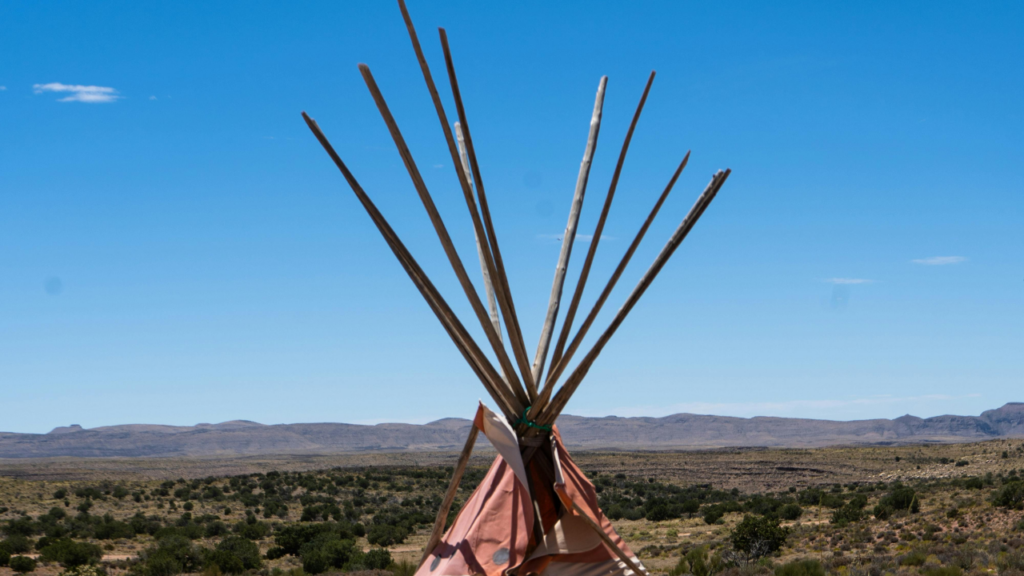
Oklahoma is home to 39 federally recognized tribes and one of the largest Native American populations in the country. Substance use disorder touches this community at a rate higher than nearly any other, not because of any failure of character, but because of the weight of what has been carried across generations. If you’re looking for residential addiction rehab that takes that history seriously, this is what you need to know.
Great Plains Recovery, located in south Tulsa, provides residential addiction treatment, medical detox, and partial hospitalization for people across Oklahoma, including those with Native American heritage. Our dual diagnosis model, trauma-informed care, and structured daily program are designed to address the root causes of addiction, not just the symptoms.
Key Takeaways
- Substance use disorder rates are significantly higher among Native American communities in Oklahoma, driven in part by historical trauma and compounded mental health conditions.
- Effective addiction rehab must address what’s underneath the addiction (trauma, depression, anxiety, PTSD), not just the substance use itself.
- Great Plains Recovery does not offer tribally specific ceremonial programming, but our Sanctuary Model and EMDR therapy are built to treat complex and intergenerational trauma.
- We accept most major insurance and can help navigate Indian Health Service (IHS) coverage and tribal health benefits.
- Most of Oklahoma is within two to three hours of our south Tulsa facility, and for many clients, that distance is part of what makes addiction rehab work.
Why Substance Use Affects Native American Communities at Higher Rates
The Role of Historical Trauma and Generational Grief
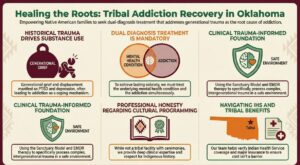
Historical trauma is not a clinical abstraction. It’s the accumulated weight of forced relocation, boarding schools that stripped children of their language and identity, and generations of policies designed to sever people from their land, their culture, and each other.
That weight shows shows up in elevated rates of depression, PTSD, and anxiety. When untreated mental health conditions go unaddressed, substance use often follows.
In Oklahoma’s tribal communities, this plays out against a backdrop of underfunded healthcare, geographic isolation, and an institutional medical system that has given many people legitimate reasons not to trust it.
The hesitation to seek addiction rehab, especially at a non-tribal facility, makes sense.
Sobriety that doesn’t address the grief, the trauma, and the underlying mental health conditions doesn’t hold. This is why dual diagnosis treatment (treating addiction and mental health simultaneously) isn’t optional. It’s the only approach that actually works for most people in this situation.
Meth, Fentanyl, and the Poly-Drug Reality in Oklahoma
Oklahoma’s substance use crisis is one of the most severe nationally, marked by a 21-fold increase in methamphetamine deaths since 2007, according to the Oklahoma State Health Department.
- Fentanyl’s Lethal Impact: Fentanyl has made the opioid supply unpredictable and lethal.
- Poly-Drug Reality: The presenting problem is often not a single substance, but a combination (e.g., meth and alcohol, opioids and benzodiazepines).
- Disproportionate Effect on Rural/Tribal Areas: Rural and tribal communities in eastern and western Oklahoma are disproportionately affected.
- Lack of Treatment Access: Residential treatment options are scarce or nonexistent in many communities far from major cities like Lawton, Muskogee, Durant, and McAlester.
- Need for the Right Treatment: Residential rehab can work, but it requires the right kind of treatment.
What Culturally Responsive Addiction Treatment Actually Looks Like
Trauma-Informed Care as the Foundation
Trauma-informed care is a clinical framework, not a slogan. At Great Plains Recovery, it’s the foundation of how the entire facility operates, not just what happens in individual therapy sessions.
Patients using the Sanctuary model to shape the culture of the building. It will help how staff interacts with clients, how conflict is handled and how safety is maintained. It’s a structured approach developed specifically to create healing environments for people who have experienced complex trauma.
Within that framework, EMDR (Eye Movement Desensitization and Reprocessing) is one of the most effective trauma-processing therapies available. People carrying layered trauma: personal loss, family trauma, and the longer historical grief don’t have a single starting point. CBT and DBT provide additional structure for managing thought patterns and emotional regulation. The 12-Step component is integrated throughout, not treated as an afterthought.
What We Offer — and What We’re Honest About
Great Plains Recovery is not a tribally operated center. We don’t offer Indigenous-specific ceremonial programming or traditional healing practices. We want to be clear about that, because this audience has been misled by healthcare institutions too many times to deserve anything less than directness.
What we do offer is clinical depth, a genuinely trauma-informed environment, and a dual diagnosis program that addresses the mental health conditions (including those shaped by historical and generational trauma) that drive substance use. Our medical director is a Fellow of the American Society of Addiction Medicine and board-certified in both addiction medicine and internal medicine. This is serious clinical work in a facility designed for healing: modern, clean, calm, and nothing like the institutional dread some people carry into their first call.
Dual Diagnosis Treatment: Addressing What’s Underneath
Dual diagnosis treatment means treating both the substance use disorder and the co-occurring mental health condition (depression, PTSD, anxiety, bipolar disorder) at the same time, by the same clinical team. Most people in addiction rehab need this. Among people from communities shaped by historical trauma, it’s close to universal.
Treating only the addiction is like treating a fever without treating the infection causing it. The symptom may resolve temporarily, but the underlying condition remains. So many people cycle through treatment without staying sober. They were treated for the surface problem, not the root causes. At Great Plains, dual diagnosis isn’t a specialty track. It’s the baseline.
If you’re looking for addiction rehab that addresses the root causes of addiction with clinical depth and genuine compassion, our team can walk you through what care at Great Plains looks like. Reach out 918-731-3173 for a confidential conversation.
What to Expect at Great Plains Recovery
Safe Medical Detox and a Structured Daily Schedule
Medical detox is the essential first phase for most clients. Withdrawal from substances like alcohol, opioids, or benzodiazepines can be medically serious, which is why safe detox is provided with:
- 24/7 Clinical Monitoring: Continuous supervision for safety.
- Medical Supervision: Medication-assisted treatment (MAT) is used where appropriate.
- Elimination of Home Risk: Safe detox is not something that should be done at home.
Following detox, clients enter the 70+ bed residential program. The structured daily schedule (8am to 6pm) replaces the chaos of addiction with predictability, which is key to early recovery.
- Daily Program: Includes group therapy, individual sessions, and skill-building.
- Therapeutic Environment: The south Tulsa facility is designed to be calming, serene, and well-maintained.
- Evenings: Less structured but always supervised.
Integrated Family Involvement
Addiction affects the entire family, and recovery requires support. Your family will be with you every step of the way.
- Core Components: Family therapy, education on the disease of addiction, and coaching on how to support recovery without enabling.
- Remote Participation: Family members from far locations (e.g., Enid, Woodward, rural Oklahoma) can participate remotely, ensuring distance is not a barrier to support.
How to Start Treatment at Great Plains Recovery
The Admissions Process: What Happens When You Call
When you call our admissions team, they will ask you what’s going on, what substances are involved and what level of care makes the most sense. This isn’t an intake form; it’s a conversation. We’ll explain what treatment looks like, answer questions about the facility and the program, and help you figure out next steps without pressure.
If your loved one is ready to come in, or if you’ve reached a point where you need to act, we can typically begin the admissions process the same day.
IHS Coverage, Tribal Insurance, and Verifying Your Benefits
Great Plains Recovery accepts most major insurance and SoonerCare, for those who qualify. For clients with Indian Health Service coverage or tribal health benefits, our admissions team can help navigate the verification process. These insurance pathways are ones we’re familiar with, and we’ll work through the details with you. If you’re unsure what your benefits cover, the fastest way to find out is to use our online insurance verification tool or call and let us run the verification for you.
Cost should not be the reason someone doesn’t get treatment. If there are coverage gaps, we’ll have an honest conversation about options.
Getting to Tulsa from Rural and Tribal Communities Across Oklahoma
Our south Tulsa facility is roughly two to three hours from most of the state. From Lawton, it’s about two hours. If you are driving from Muskogee, McAlester, or Durant, about 90 minutes to two hours. From Enid or the northwest, roughly two and a half hours. For clients coming from western Oklahoma where no residential option exists locally, Tulsa is a realistic drive, not a barrier.
For many clients, the distance is part of what makes treatment work. Getting out of the environment where addiction happened, away from familiar triggers creates separation that early recovery often requires.
Frequently Asked Questions
- Does Great Plains Recovery have experience treating Native American clients? Yes. We serve clients from across Oklahoma, including from tribal communities throughout the state. Our team understands the compounded and generational trauma that many Native American clients bring into treatment.
- Does Great Plains accept Indian Health Service (IHS) coverage or tribal insurance? We accept most major insurance and can work with clients who have Indian Health Service coverage or tribal health benefits. Contact our admissions team directly to verify your specific benefits.
- How far is Great Plains Recovery from eastern Oklahoma and tribal communities? Our south Tulsa location puts us within roughly 90 minutes to two hours of most eastern Oklahoma communities, including Muskogee, Tahlequah, McAlester, and Durant. Family members who cannot make the drive can participate in therapy remotely.
- What does a typical day look like in residential treatment at Great Plains? The structured daily schedule runs from 8am to 6pm and includes group therapy, individual therapy, skill-building sessions, and educational programming. Evenings are less scheduled but supervised.
- How do I know if my loved one needs residential rehab versus outpatient care? If there’s a physical dependence on alcohol, opioids, or benzodiazepines, safe medical detox is usually the first step, and that typically means residential care. If you have tried outpatient treatment before without lasting results, residential treatment provides the necessary separation and structure.
- What steps do I need to take to get my loved one admitted? Call our admissions line. A recovery specialist who will assess the level of care needed, verify insurance, and walk you through next steps.
Start Your Admission
You don’t have to face addiction rehab alone. Call the admission team at Great Plains Recovery at 918-731-3173 or our online form on our contact us page.
Learn More
If you or someone you love is in crisis, these resources are available 24/7:
- National Institute of Health: Substance and Behavioral Addictions Among American Indians
- Oklahoma State Health Department
- Cleveland Clinic: Dual Diagnosis
- SAMHSA National Helpline: 1-800-662-HELP (4357)
- 988 Suicide & Crisis Lifeline: Call or text 988
- National Institute on Alcohol Abuse and Alcoholism
- American Psychology Association: Substance Abuse Addiction in Native American Youth
- Indian Health Services: Alcohol and Substance Abuse Branch
- University of Minnesota: Native American Youth and Substance Abuse
- Mayo Clinic: Substance Use Disorder
- Medlineplus.gov: Substance Use Disorder